Previous Post:
A visit to Castlefield, Manchester with Sarah
Hello! I am Sarah, I am from France and I work as a Marketing Officer at The Essential English Centre! Over the next few weeks,...


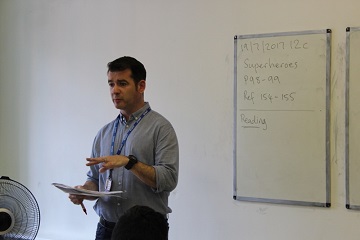
IELTS teacher Patrick talks you through some useful tips and advice for the writing section of the IELTS Academic exam:
IELTs Academic Writing
Question Types
In the writing section of the IELTs academic test there are 2 tasks.
An example of this question type can be found here:
It could be an essay question asking you to…
Here is a website where you find plenty of examples of questions you might need to answer.
Can you find an example of each type (A-D) on the website?
Grammar and Vocabulary
With both tasks 1 and 2 it is important that you have the necessary grammar and vocabulary to answer the questions which might come up. Obviously you can’t predict the topic of the question but there are some aspects of grammar and vocabulary that are more likely to come up than others. Can you match the following language points with the relevant task(s)?
general structures for cause and consequence (X causes Y to happen/ This is usually due to X/ X has a major impact on Y)*
structures for introducing positives and negatives (One positive point about X is…/ Another major drawback of doing X is….)**
comparatives (X is much better than Y/ X is not nearly as good as Y)***
conditional structures for expressing consequence (This would almost certainly lead to…, There is a fair chance that this could make it easier to…)****
passive structures for introducing common opinions/ beliefs (It is widely believed that…., X is often though to be…)*****
Although some of the language points above could be useful with more than one task, I’d suggest that the most commonly appropriate areas are as follows: 1***, 2A*****, 2B**, 2C****, 2D*.
If there are any areas which you think you need more practice with or any other language that you think will be more likely to come up in the writing exam it’s worth making the effort to focus on these areas.
It’s a very good idea to look at sample answers and try to extract good examples of language and re-use them in your own work. It also gives you a better idea of what the examiner is looking for, particularly if you can find examples with examiner’s comments attached.
These 2 examples from the British Council website are a good start but there are many other useful resources you can find on the internet.

Previous Post:
Hello! I am Sarah, I am from France and I work as a Marketing Officer at The Essential English Centre! Over the next few weeks,...
Next Post:
Hi, I’m Jamie and I teach English here at The Essential English Centre. At the moment I’m teaching a wonderful group of intermediate students from...